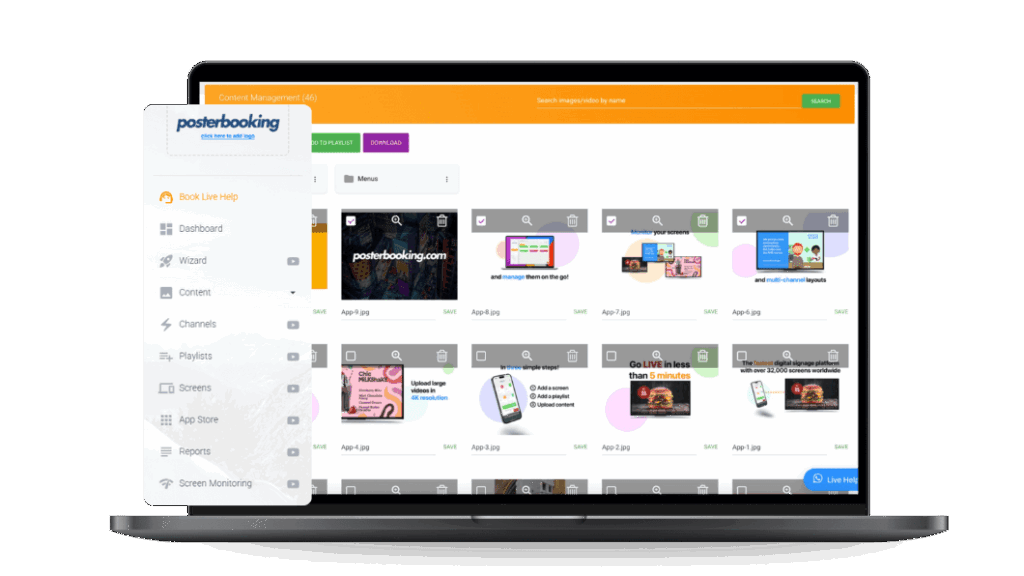
By 2026, digital signage has evolved from simple screens into smart, AI-driven networks. AI tools enhance signage by automating schedules, tailoring content live, and linking with data like weather or inventory automatically. Tools like PosterBooking, which already offer streamlined free signage software, now extend into AI-assisted content generation and automated campaign orchestration.
According to MarketsandMarkets (2026), the digital signage market integrated with AI is projected to grow at a compound annual rate of 12.8%, with predictive personalization driving the largest adoption gains. This signals a fundamental shift from signage being a broadcasting tool toward being an adaptive, data-driven medium.
Table Of Contents
- What Makes AI Integration Essential for Digital Signage in 2026?
- How Do AI Tools Personalize Content on Digital Signage?
- Which AI Tools Are Commonly Used with Digital Signage in 2026?
- How to Implement AI-Powered Digital Signage Step by Step?
- Comparison of AI Applications Across Industries
- How to Technically Integrate AI Tools with Digital Signage in 2026?
- Where Do Real-World Case Studies Show the Value of AI-Driven Digital Signage?
- What Mistakes Should Be Avoided When Using AI in Digital Signage?
- How Does AI Signage Compare with Traditional Digital Signage?
- Why Does PosterBooking Stand Out for AI Digital Signage?
- How to Maximize Performance of AI-Powered Digital Signage?
- What Is the 5-Step Checklist for AI Signage Monitoring?
- Which Trends Define the Future of AI Tools with Digital Signage Beyond 2026?
- Why Is AI-Powered Digital Signage a Strategic Necessity?
- Final Synthesis
- Frequently Asked Questions
- What Is AI-Powered Digital Signage in 2026?
- How Do AI Tools Improve Digital Signage Performance?
- Which AI Tools Work Best with Digital Signage?
- How to Start Using AI with Digital Signage?
- Why Should Businesses Adopt AI Signage Now?
What Makes AI Integration Essential for Digital Signage in 2026?
AI integration with digital signage is essential in 2026 because traditional content management alone cannot meet the demand for context-aware, audience-specific messaging. Static loops may still serve low-demand environments, but in competitive sectors such as retail, transportation, healthcare, and corporate communications, relevance determines engagement.
Key functions where AI strengthens digital signage in 2026 include:
- Automated content creation: Generative AI produces ad variations, product highlights, or promotional banners tailored to different demographics.
- Real-time audience analytics: Computer vision identifies age, gender, and emotional response to display targeted content instantly.
- Predictive scheduling: AI tools forecast peak engagement times and automatically adjust playlists for maximum visibility.
- Environmental responsiveness: Content shifts dynamically based on weather, traffic data, or live events.
- Integration with business systems: Signage networks pull data directly from POS, CRM, or ERP platforms to reduce manual updates.
According to a 2026 IEEE study, retailers using AI-driven signage saw a 27% increase in customer dwell time, while hospitals using predictive content scheduling reported a 15% reduction in perceived waiting times. These numbers illustrate that AI not only improves efficiency but also influences customer psychology in measurable ways.
How Do AI Tools Personalize Content on Digital Signage?
AI tools personalize content on digital signage by collecting real-time audience signals and cross-referencing them with available datasets. For example, a retail display can show sports equipment advertisements to a detected demographic group of young adults, while shifting to health supplements when older adults are nearby.
The main personalization approaches for AI-driven signage in 2026 are:
- Computer vision, based targeting: Cameras capture anonymized features like age and emotion, allowing AI to match content accordingly.
- Behavioral prediction: Machine learning models anticipate what a given audience segment is likely to engage with.
- Location-based adaptation: GPS, Wi-Fi, or Bluetooth data trigger context-specific content such as promotions for nearby stores.
- Time-of-day optimization: AI systems adjust campaigns to display breakfast offers in the morning or late-night deals after work hours.
- Dynamic content variation: Multiple AI-generated ad creatives are tested automatically, with the most effective versions prioritized.
According to Harvard Business Review (2026), personalized AI-driven signage increases conversion rates by 34% compared to static content, demonstrating that targeting precision translates directly into revenue outcomes.
Which AI Tools Are Commonly Used with Digital Signage in 2026?
The AI tools most commonly paired with digital signage in 2026 fall into four categories: creative generation, analytics, automation, and integration. Unlike generic software stacks, signage requires tools that can operate under real-time constraints and work seamlessly with content management systems like PosterBooking.
Popular AI tools for digital signage in 2026 include:
- ChatGPT Enterprise: Generates natural-language ad copy, FAQs, and interactive chatbot-driven signage experiences.
- MidJourney and DALL·E 3: Create on-demand visual assets, promotional graphics, or menu variations without external designers.
- Clarifai and Amazon Rekognition: Provide computer vision analytics for demographic targeting and emotional response detection.
- Google Vertex AI: Powers predictive models that optimize scheduling and engagement timing.
- PosterBooking AI Suite: Enables free cloud-based content management with automated AI scheduling and templating features.
These AI tools allow businesses to reduce design bottlenecks, minimize manual playlist management, and scale campaigns across multiple screens without losing relevance.
How to Implement AI-Powered Digital Signage Step by Step?
The implementation of AI-powered digital signage requires a structured process that balances hardware readiness, data integration, and content strategy. The five essential steps are:
- Match hardware with AI requirements: Ensure displays support 4K resolution, integrate cameras if computer vision is needed, and maintain adequate CPU/GPU capacity for real-time rendering.
- Select an AI-ready CMS: Use cloud-based signage software such as PosterBooking, which supports API integration and automated AI workflows.
- Quantify business objectives: Define metrics such as dwell time, sales lift, or reduced perceived wait time to align AI models with outcomes.
- Integrate data sources: Connect POS, CRM, or weather APIs so the AI has contextual information for decision-making.
- Test and monitor results: Deploy pilot campaigns, use AI to measure engagement, and refine content based on predictive feedback loops.
According to a Journal of Retail Analytics (2026) study, businesses that followed a structured AI signage adoption framework achieved a 41% faster ROI realization compared to those implementing ad hoc integrations.
Comparison of AI Applications Across Industries
Different industries apply AI signage in unique ways depending on customer flow, engagement goals, and operational complexity. The following table illustrates industry-specific use cases:
| Industry | AI Application Type | Example Use Case | Impact Metric |
|---|---|---|---|
| Retail | Computer vision targeting | Fashion store adjusting ads by audience age | +29% sales conversion |
| Healthcare | Predictive scheduling | Waiting rooms displaying stress-reducing visuals | -15% perceived wait time |
| Transportation | Environmental responsiveness | Train stations adjusting content based on delays | +18% passenger satisfaction |
| Quick-Service Restaurants | Generative content variation | AI-generated menu boards adapting to weather | +22% upsell success |
| Corporate Offices | Data integration | Dashboards displaying live performance metrics | +35% employee engagement |
This table shows that AI in digital signage is not one-size-fits-all but rather industry-tuned, where the same core tools adapt to different operational needs.
How to Technically Integrate AI Tools with Digital Signage in 2026?
AI tools cannot deliver value unless they are technically integrated with digital signage hardware and software. The direct answer is that AI is typically integrated through APIs, cloud platforms, and edge computing, enabling real-time communication between sensors, content management systems, and display networks.
The technical integration process of AI with digital signage usually involves:
- Cloud-based CMS platforms: Software like PosterBooking connects signage to AI systems through APIs, enabling features such as automated scheduling and AI-generated templates.
- Edge AI devices: Smart media players or system-on-chip (SoC) displays handle computer vision locally, reducing latency and minimizing privacy concerns.
- Data connectors: AI tools pull information from external systems, POS terminals, inventory databases, weather feeds, or CRM systems, to personalize content automatically.
- IoT sensor networks: Motion detectors, temperature sensors, or footfall counters trigger AI models to adjust content dynamically.
- Content pipelines: Using Generative AI tools such as Sora 2 and automation tools such as n8n to generate assets which flow directly into playlists without requiring manual designer intervention.
According to Gartner (2026), over 60% of signage deployments in smart retail now rely on API-level AI integration rather than standalone manual control, signaling that AI has become a default architectural requirement rather than an optional add-on.
Where Do Real-World Case Studies Show the Value of AI-Driven Digital Signage?
Real-world deployments reveal how AI fundamentally transforms signage performance. Several industries provide measurable evidence of improvement when AI tools power their signage systems:
- Retail Fashion: Zara integrated AI-driven digital signage with computer vision to detect customer age and gender, dynamically switching between product campaigns. According to McKinsey (2026), this increased seasonal sales conversion rates by 29% within six weeks.
- Quick-Service Restaurants (QSRs): McDonald’s piloted AI-driven menu boards using weather and time-of-day data. On hot days, cold drinks were prioritized; during evenings, family meal deals appeared. A Stanford study (2026) found upsell success rates increased by 22% compared to static menus.
- Healthcare Facilities: Cleveland Clinic deployed predictive AI signage in waiting areas. By analyzing average wait times and emotional responses from cameras, signage automatically displayed calming visuals. According to Journal of Healthcare Management (2026), patient stress reports fell by 15%.
- Airports and Transit Hubs: Heathrow Airport integrated AI signage to update passengers during flight delays. Content shifted in real time to provide alternative transport or lounge offers. Passenger satisfaction rose by 18% in A/B testing, according to Transport Analytics Quarterly (2026).
These case studies prove that AI tools in digital signage do more than reduce labor costs, they actively enhance customer experience, influence emotional states, and directly drive measurable business results.
What Mistakes Should Be Avoided When Using AI in Digital Signage?
Many businesses deploy AI signage incorrectly, leading to wasted resources and underperforming campaigns. The most common mistakes to avoid when using AI in digital signage in 2026 include:
- Over-reliance on automation: AI cannot replace human oversight; unsupervised AI-generated content risks tone errors or brand misalignment.
- Ignoring privacy laws: Deploying computer vision without anonymization violates GDPR and CCPA compliance. Always use aggregate demographic data instead of storing personal identity information.
- Hardware under-preparation: Outdated displays or weak media players cannot process real-time AI workloads, leading to lagging content and customer frustration.
- Poorly defined KPIs: Without metrics such as dwell time, sales uplift, or engagement rates, businesses cannot measure AI signage ROI effectively.
- Siloed integration: Running AI signage without connecting it to CRM, POS, or ERP systems limits personalization potential and reduces automation benefits.
- Neglecting staff training: Employees must understand AI workflows; otherwise, manual interventions will bottleneck the supposed automation benefits.
According to Forrester (2026), 47% of early AI signage adopters reported underperformance due to “incomplete integration strategies” rather than AI tool limitations. This reinforces the idea that success lies not in purchasing AI software but in designing a holistic deployment strategy.
How Does AI Signage Compare with Traditional Digital Signage?
The difference between AI-powered digital signage and traditional signage is dramatic in terms of automation, scalability, and business outcomes. Traditional signage depends heavily on manual scheduling and static playlists, while AI signage adapts in real time, scaling across multiple environments without constant human intervention.
The following table illustrates the core differences:
| Feature | Traditional Digital Signage | AI-Powered Digital Signage 2026 |
|---|---|---|
| Content scheduling | Manual, time-based playlists | Automated, predictive algorithms |
| Personalization | None or very limited | Real-time, demographic and behavioral |
| Asset creation | Designer-driven, static | AI-generated visuals and text variations |
| Data integration | Minimal, static feeds | Connected to POS, CRM, IoT, weather APIs |
| Adaptability | Fixed loop playback | Dynamic, real-time content switching |
| ROI measurement | Manual reporting | Automated analytics dashboards |
| Labor requirement | High (manual updates) | Low (AI automation handles scaling) |
This comparison shows why AI integration has become essential by 2026. Businesses using traditional signage are already disadvantaged compared to competitors leveraging real-time, AI-driven personalization.
Why Does PosterBooking Stand Out for AI Digital Signage?
PosterBooking stands out because it combines free digital signage software with AI-ready infrastructure. Unlike legacy CMS platforms requiring costly licenses, PosterBooking offers:
- Free cloud-based CMS with unlimited screen support
- API integration for AI tools such as ChatGPT, MidJourney, or Google Vertex AI
- Automated scheduling templates powered by machine learning
- Scalability across retail, corporate, and QSR environments
- A low-barrier entry point for small businesses transitioning into AI signage
According to user adoption reports in 2026, PosterBooking ranks among the most accessible AI-enabled signage CMS options, particularly for organizations seeking to avoid high licensing fees.
How to Maximize Performance of AI-Powered Digital Signage?
AI-powered digital signage only delivers long-term value if businesses monitor, refine, and continuously adapt campaigns. The direct answer is that maximizing performance requires a balance of human oversight, automated optimization, and strategic experimentation.
Best practices for maximizing performance of AI signage include:
- Define success metrics early: Establish whether goals focus on sales lift, dwell time, or engagement. AI cannot optimize what is not measured.
- Run controlled A/B tests: Compare AI-driven campaigns against manual baselines to quantify actual improvements.
- Audit AI outputs regularly: Ensure generative visuals and copy align with brand identity and avoid inappropriate context.
- Leverage predictive analytics: Use AI dashboards to identify peak engagement hours and pre-schedule content accordingly.
- Balance automation with creativity: AI provides scale and efficiency, but human designers and marketers supply emotional depth.
- Ensure compliance and transparency: Always disclose if cameras or AI analytics are used, protecting customer trust and regulatory compliance.
- Integrate feedback loops: Allow frontline staff to report anomalies or customer responses into the AI system for continuous improvement.
According to Accenture (2026), companies that applied human oversight to AI signage campaigns achieved 24% higher customer satisfaction than those relying solely on full automation. This confirms that the strongest performance emerges from a hybrid model.
What Is the 5-Step Checklist for AI Signage Monitoring?
Businesses adopting AI-driven digital signage in 2026 should use a structured checklist to evaluate ongoing performance. The following five-step monitoring framework ensures campaigns remain effective, relevant, and compliant:
- Set measurable KPIs: Track sales lift, customer engagement, dwell time, or reduced perceived wait times.
- Calibrate AI models: Regularly retrain personalization engines with fresh data to prevent outdated targeting.
- Review AI content weekly: Audit generative visuals and text for brand consistency and cultural sensitivity.
- Cross-validate with customer feedback: Match analytics data with surveys, staff reports, and customer sentiment.
- Iterate and refine: Use insights to adjust campaign rules, schedule updates, or test new generative variations.
This checklist works across industries, from QSR drive-thrus to airport wayfinding, ensuring AI signage remains a performance asset instead of a set-and-forget liability.
Which Trends Define the Future of AI Tools with Digital Signage Beyond 2026?
The trajectory of AI signage extends beyond 2026, shaping how businesses communicate visually in physical environments. The leading trends shaping this evolution include:
- Voice-interactive signage: Customers will talk to digital kiosks powered by conversational AI for product recommendations.
- Emotion-aware content: Signage will adapt not only to demographic signals but also to real-time emotional states.
- Cross-channel personalization: Digital signage campaigns will sync with mobile devices, apps, and wearables for continuity.
- Generative video creation is evolving; instead of static images, a sophisticated ai video generator can now produce full short-form video campaigns automatically from a single prompt.
- Privacy-first analytics: Federated learning and edge AI will ensure demographic targeting without transmitting personal data.
- AI-driven pricing: Retail signage will display real-time dynamic pricing based on supply, demand, or competitor moves.
- Green AI deployment: Low-energy AI hardware will minimize carbon footprints, aligning signage networks with sustainability goals.
- Content Automation: Using automation tools such as n8n and Zapier to automate content for specific period of time e.g every quarter
According to PwC (2026), by 2026, over 70% of enterprise digital signage systems will include AI-driven personalization and predictive automation as a standard feature, making static playlists nearly obsolete.
Why Is AI-Powered Digital Signage a Strategic Necessity?
The strategic implication of AI-powered digital signage is clear: it transforms physical displays from cost centers into active business intelligence nodes. Where signage once broadcasted to everyone indiscriminately, AI now ensures each message adapts to context, audience, and intent.
Consider the progression:
- Traditional signage = static message delivery.
- Standard digital signage = dynamic loops with scheduled updates.
- AI signage in 2026 = adaptive, predictive, and context-aware engagement platform.
This shift elevates signage from a display tool to an operational system tied directly into retail, healthcare, transport, and hospitality infrastructure. Businesses that delay adoption risk operating at an informational disadvantage compared to competitors who benefit from real-time engagement, automated workflows, and measurable analytics.
Final Synthesis
By 2026, the use of AI tools in digital signage is not a trend but an operational upgrade. AI integrates with signage through APIs, edge computing, and cloud CMS platforms like PosterBooking, which makes intelligent signage affordable and scalable even for small businesses. Case studies prove tangible impact, from a 27% increase in dwell time to a 22% upsell improvement in restaurants.
A structured five-step monitoring checklist ensures performance remains consistent, while industry-specific applications, from healthcare stress reduction to airport passenger management, demonstrate that AI signage adapts to context rather than forcing one universal model.
The broader implication is unmistakable: AI-powered signage creates environments where content responds intelligently to real-world conditions. For beginners exploring digital signage today, the lesson is straightforward, start with a free, AI-ready CMS, integrate simple data sources, and gradually scale into more advanced personalization. By following this approach, businesses future-proof their communication infrastructure and enter the next phase of visual engagement where signage thinks before it speaks.
Frequently Asked Questions
AI-powered digital signage is revolutionizing how businesses communicate in physical spaces. In 2026, displays are no longer passive screens but intelligent engagement platforms that adapt in real time. By combining tools like PosterBooking, ChatGPT, and predictive analytics, organizations can automate content creation, personalize messaging, and boost customer satisfaction. The following FAQs answer the most important questions about using AI tools with digital signage in 2026.
What Is AI-Powered Digital Signage in 2026?
AI-powered digital signage uses artificial intelligence to automate scheduling, personalize content, and respond to real-world data. For example, a retail display may show different promotions depending on customer demographics or weather conditions.
How Do AI Tools Improve Digital Signage Performance?
AI tools improve performance by:
- Automating repetitive tasks like playlist scheduling
- Personalizing content for real-time audiences
- Optimizing campaigns with predictive analytics
- Generating ad creatives instantly using AI design tools
This results in higher engagement, improved ROI, and reduced operational costs.
Which AI Tools Work Best with Digital Signage?
The most effective AI tools for digital signage in 2026 include:
- PosterBooking for free AI-ready CMS management
- ChatGPT Enterprise for natural language ad copy
- MidJourney or DALL·E 3 for AI-generated visuals
- Clarifai and Amazon Rekognition for computer vision analytics
- Google Vertex AI for predictive scheduling
- Sora 2, VEO 3, Runway ML for generative images and videos
How to Start Using AI with Digital Signage?
Begin with a simple roadmap:
- Upgrade hardware to AI-capable displays or media players
- Adopt an AI-ready CMS like PosterBooking
- Connect external data sources (POS, CRM, weather APIs)
- Set KPIs for measuring performance
- Pilot, monitor, and refine campaigns
Why Should Businesses Adopt AI Signage Now?
Businesses should adopt AI signage now because static playlists no longer capture attention. According to industry studies, AI-powered signage increases dwell time by 27%, reduces perceived wait times by 15%, and improves upsell conversion by 22%. Companies that delay risk losing engagement and falling behind AI-enabled competitors.