
Table Of Contents
- How Important Is Digital Signage for Churches?
- How Digital Signage Is Used in Churches
- How Digital Signage Is Used for Worship Services
- How Digital Signage Is Used for Announcements and Community Updates
- How Digital Signage Is Used for Church Lobbies and Entrances
- How Digital Signage Is Used for Children and Youth Ministries
- How Digital Signage Is Used for Donor and Volunteer Recognition
- How Digital Signage Is Used for Multi-Campus Communication
- How Much Does Digital Signage Cost For Churches?
Digital signage in churches involves using networked screens and cloud software to communicate across the campus - from the sanctuary to the lobby and classrooms. Here, signage serves as a dynamic tool to share sermon points, scripture, updates, volunteer notices, and inspiration that strengthen connection among members and guests. Unlike printed bulletins, digital signage updates instantly and remotely, providing the flexibility needed for modern congregations.
According to the Center for Church Communication (2026), churches using visual tools see up to 41% higher engagement regarding weekly programs. This improvement stems from visibility: screens in lobbies, halls, and courtyards ensure messages reach everyone. Technically, it relies on commercial displays (32–65”), media players, and cloud software such as PosterBooking, which provides free signage for up to 10 screens, perfect for most churches.
Digital signage operates through a CMS that schedules media and synchronizes displays. It allows pastors, admin, or volunteers to push content instantly without needing tech skills. For instance, a pastor can upload slides while a volunteer updates youth events - all from the same dashboard.
By connecting spiritual messages with visual clarity, signage turns ordinary spaces into storytelling environments that seamlessly blend worship, info, and inspiration.
How Important Is Digital Signage for Churches?
Digital signage is now a vital communication tool because it bridges the gap between physical services and digital interaction. As congregations grow, traditional paper bulletins and verbal notes often fail to reach everyone.
Per Faithlife Research (2026), churches using signage see a 27% lift in event participation and 33% faster volunteer coordination than those using print only. The immediacy of on-screen updates means members are never left behind due to delays.
The benefits span both spiritual connection and efficiency:
- Spiritual Connection: Screens showing verses or lyrics focus attention and unity. Visual storytelling boosts understanding, especially for visual learners.
- Efficiency: A cloud network guarantees consistent messaging across all services. Every service gets the same info, minimizing confusion.
- Environmental Stewardship: Churches save by cutting reliance on paper. For instance, one church saved nearly $2,400 annually after switching to digital.
- Community Cohesion: Unified visual identity builds familiarity, creating an integrated communication ecosystem that reinforces the mission.
Digital signage doesn't replace human contact; it amplifies it. When used to highlight stories, promote ministry, or share prayers, the congregation feels closer. It is, in essence, an instrument of belonging.
How Digital Signage Is Used in Churches
Churches use signage across campus to support worship, communication, and community goals. Common use cases include:
- Enhancing worship with visuals
- Communicating announcements clearly
- Welcoming visitors in lobbies
- Educating youth with engaging content
- Recognizing donors and volunteers
- Coordinating multi-campus efforts
How Digital Signage Is Used for Worship Services
Churches use signage to enrich worship. By displaying lyrics, verses, outlines, and backgrounds, signage helps keep the congregation focused.
For instance, lyric projection helps people sing without fumbling with hymnals. During sermons, supporting visuals reinforce points, helping with note-taking. A 2022 Barna Group study noted that visuals improved sermon recall by 19%.
Modern systems sync visuals, lighting, and ambient loops - matching the sermon theme. PosterBooking lets churches pre-schedule these visuals or trigger them live, ensuring smooth transitions.
How Digital Signage Is Used for Announcements and Community Updates
Churches use signage for community updates to ensure every member knows what is happening during the week. Instead of cluttered boards, screens present events, prayer meetings, and outreach in a clear format.
For example, a screen near the exit might scroll slides for “Youth Worship,” “Volunteer Training,” and “Christmas Choir.” Because signage supports motion, these announcements capture more attention than static posters.
Per Pro Church Tools (2026), digital announcements get 48% more views than printed ones. Using a tool like PosterBooking, congregations can rotate content automatically - cutting out the manual work of hanging and taking down posters.
The biggest win is timing: messages change instantly. If a meeting time shifts, the update appears on every screen in seconds.
How Digital Signage Is Used for Church Lobbies and Entrances
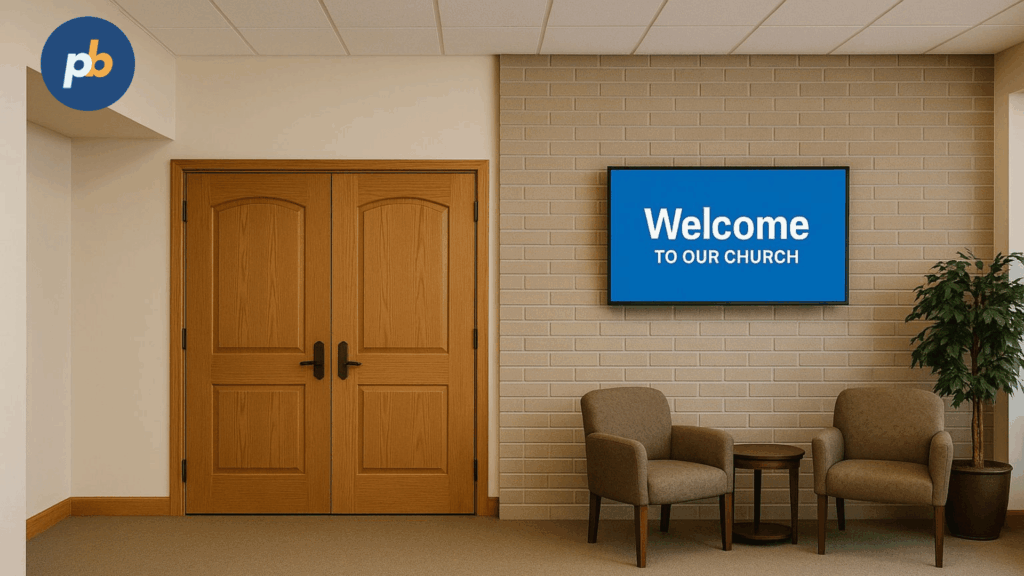
Churches use signage in lobbies to create a welcoming first impression. A screen at the door acts as a digital greeter, showing welcomes, times, and quotes that set a positive tone.
Common content includes:
- Welcome messages for each service
- Inspiring quotes or verses
- Maps to rooms and halls
- Event highlights
- Safety or accessibility info
For example, Trinity Fellowship Church uses LED displays to orient visitors and promote sermon series. PosterBooking’s cloud scheduling lets volunteers pre-load greetings and weekday content, saving setup time.
How Digital Signage Is Used for Children and Youth Ministries
Churches use signage in youth areas to build safe, engaging spaces. Kids' areas use screens for fun lessons and security alerts, while youth rooms show motivational content and event schedules.
For instance, a classroom might show a looping video on kindness, while a youth area shows “Youth Camp 2025 - Registration Open.” According to MinistryTech (2026), visuals in children’s education boost recall by 35%.
PosterBooking’s interface makes it simple to manage content across rooms, letting teachers update slides easily. Beyond education, safety is improved - screens can display emergency notices instantly.
How Digital Signage Is Used for Donor and Volunteer Recognition
Churches use signage for recognition to celebrate those who sustain the ministry. Instead of plaques, screens continuously highlight generosity through vibrant visuals.
For example, a “Thank You Wall” in the lobby might feature volunteer photos, milestones, or snapshots of mission trips. Giving USA (2026) notes that visible recognition can increase repeat giving by 22%.
PosterBooking allows automatic scheduling of these slides, which can be updated monthly or after events. Churches can even mix in testimony videos, showing the real impact of service.
How Digital Signage Is Used for Multi-Campus Communication
Churches use signage for multi-site communication to stay unified. Large ministries operate in many cities, yet digital signage ensures themes and branding are identical everywhere.
The core advantage is sync. A central CMS like PosterBooking allows content teams to schedule visuals for every branch at once. A graphic uploaded in one city appears everywhere in minutes, preventing version errors.
Per ChurchTechToday (2026), multi-campus churches with connected signage see 56% fewer communication errors. Digital signage also supports streaming: satellite branches can show synced lyrics or sermon highlights.